
Quick Facts
- Historic century
- Unbeaten 105 off 50 balls vs Bhutan, 8 March 2003, ACC Emerging Nations Tournament — Nepal's first international century
- Debut
- Nepal vs Bangladesh, ACC Trophy, Malaysia, September 1996
- Captaincy
- Captained Nepal in the early 2000s; led the side to the 2002 ACC Trophy final
- Last match
- Nepal vs UAE, ICC Intercontinental Cup, 2004
- Now
- Sports teacher at Little Flower School, Narayangarh, Chitwan, for around 20 years; runs Chitwan Cricket Academy
- NPL season 3
- Not invited; invited to seasons 1 and 2. Helped Chitwan Rhinos select players at their talent hunt this season
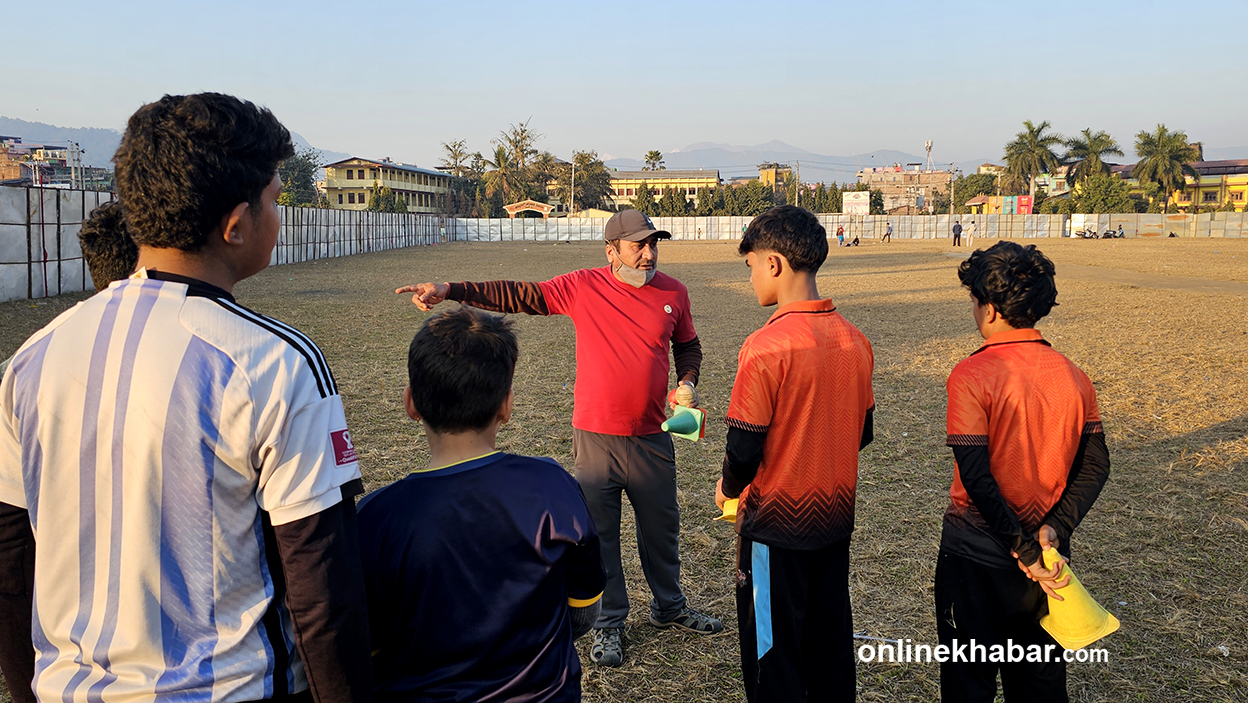
On the morning of the biggest day in Nepali domestic cricket, with Lumbini Lions and Sudurpaschim Royals preparing to meet in the Nepal Premier League final at the TU International Cricket Ground in Kirtipur at 5:00 PM NST, the man who scored Nepal's first international century was a long way from the ground. Raju Khadka was in Narayangarh, Chitwan, on the ground of Little Flower School, coaching a group of schoolchildren in football and cricket. He had not been invited to the third season of the league, and he had not gone.
A former captain watches from home
It is a strange place for a former national captain to be on final day. Khadka is not a forgotten name from a distant era. He is the batsman who made Nepal's first international hundred, the captain who led the country to an ACC Trophy final, and the coach who trained the leg-spinner who would become Nepal's most famous cricketer. Yet as the third season of the NPL reaches its climax, he has watched it the way most supporters do, from home, while the tournament he helped make possible plays out without him.
Asked why he had not gone to watch the league, his answer was short. No, he said, the invitation did not come. He was invited to the first season and to the second, and he went. This time, the Cricket Association of Nepal did not remember him. It was not said with anger. It was said the way a man says something he has already made his peace with, even if the peace is incomplete.
That does not mean he does not want to be there. He does. He has spent enough of his life on the country's cricket grounds that the pull of them has never left him. He has said that his mind still wanders to the grounds where he played, and that sitting in the VIP parapet as a former captain, watching the game he gave his best years to, is something he would naturally want. Sometimes, he admits, he thinks about simply buying a ticket and going. Then another part of him tells him to stay home and watch it there instead. Friends from the district have asked him to go with them. He has found excuses and stayed away.
What he asks for is not a job or a favour. It is recognition. He believes the seniors who built Nepali cricket deserve to be honoured, and that respecting them is part of Nepali culture itself. His point is not about him alone. Paras Khadka, the most celebrated captain in the country's history, is now the secretary of the cricket association. But the former captains from the generation before him, the men who led Nepal when there was little money, little attention and no league of this size, are rarely sought out. Khadka feels that absence more keenly than most, because he is living it.
The hundred that made history
To understand why his absence matters, it helps to remember what he did. On 8 March 2003, at the TU Ground in Kirtipur, the same ground where today's final is being played, Nepal faced Bhutan in the ACC Emerging Nations Tournament. Khadka, captaining the side, walked in and made an unbeaten 105 from just 50 balls, with 14 fours and four sixes. Nepal won the match by 353 runs, and he was named player of the match. It was the first century by a Nepali in international cricket, and it stood as a marker for everything that followed.
He had been part of the national set-up since its earliest days. He made his debut for Nepal against Bangladesh in September 1996, in the ACC Trophy in Malaysia, under the captaincy of Uttam Karmacharya, and took two wickets in that first match, a game interrupted by rain. He played in the ACC Trophy again in 1998, 2000 and 2002, and captained Nepal in the early 2000s, leading the side to the final of the 2002 ACC Trophy, where Nepal finished runners-up. That run was one of the first moments when Nepali cricket began to be talked about beyond its own small circle. A right-handed batsman and a right-arm medium-fast bowler, he was the kind of all-rounder every young team leans on, good enough with both skills to hold a place on either one alone.
His international career ended where so many early Nepali careers ended, quietly and without ceremony. His last match for Nepal came in 2004, in the ICC Intercontinental Cup against the United Arab Emirates. He was 29. The professional structures that today's players take for granted did not exist yet, and there was no league to come home to.
The coach in Chitwan
What he did next explains more about Nepali cricket than any single innings. He went back to Chitwan, where he lives, and started again at the bottom of the game. For around 20 years he has worked as a sports teacher at Little Flower School in Bharatpur, and he runs the Chitwan Cricket Academy, also known as the Chitwan Training Centre, at Campa Chaur, where around 40 school-age boys train under him. He is also a member of the Chitwan District Cricket Association.
The most famous of his students is Sandeep Lamichhane. The leg-spinner moved to Chitwan and trained at the academy run by Khadka, and it was there, during a visit by then captain Paras Khadka and coach Pubudu Dasanayake, that the 14-year-old was asked to bowl in the nets and picked for the national under-19 training camp. The rest of that story is well known. Lamichhane went on to the Indian Premier League, to the captaincy of Nepal, and to becoming the face of Nepali cricket around the world. In 2018, the two of them were felicitated together in Bharatpur, the mentor and the student, and Khadka recalled that Lamichhane had joined his academy two years earlier.
Lamichhane is not the only one. Khadka says 14 of the players he has coached have gone on to represent Nepal at under-16, under-19 or national level, among them Gautam KC, Pratik Shrestha, Dipesh Shrestha and Saugat Dhakal. The numbers are his own, and they describe a life spent doing the least glamorous work in the sport, finding children, teaching them the basics, and sending them on to bigger stages than his own.
The Rhinos link that never happened
That work is also why his distance from the NPL stings. Chitwan has its own franchise, the Chitwan Rhinos, owned by Chitwan Medical College, and the team has played all three seasons of the league. Khadka wanted to be part of it in some role. He has said that in the first season there was talk of him joining the Rhinos as a coach, but it never happened. The chance did not come again.
He did not disappear entirely from the franchise's orbit. This season he took part in the Rhinos' talent hunt and helped select players. It is the kind of contribution that suits him, quiet and practical, and it is also the kind that leaves no trace on a broadcast. The players he helped pick are in the system. He is still outside it.
What he makes of today's cricket
He still watches the game closely, and he is not shy about what he sees. Nepal's 26 all out against India A in the Asia Cup Rising Stars tournament in Qatar on Friday left him saddened, and he has said he never imagined a Nepal side chasing the goal of becoming a Test-playing country would produce a performance that weak. His reading of the problem is a coach's reading. Nepal, he believes, has focused too much on T20 cricket and produced players in that image, while the patience and skill needed for longer cricket have been neglected. In a 50-over match, he argues, patience and partnerships are what help the players themselves.
He takes the same measured view of the overseas players in the NPL. They are better than the local players, he says, and they should be brought in. But the idea that they should carry the batting line-up and win the matches is wrong. Nepali players should be learning skills and technique from them, and building their own level and confidence, rather than leaning on them. It is the view of a man who has spent two decades teaching children that the work matters more than the shortcut.
As the final plays out in Kirtipur, that is the distance between the two ends of Nepali cricket. On one side is a league with floodlights, franchises, overseas stars and a packed ground, the festival the whole country is watching. On the other is the school ground in Narayangarh, where the man who scored the country's first international hundred teaches children to hold a bat properly. The league exists because players like him laid its foundations when there was nothing to build on. He does not ask for much. He would like to be remembered, and to be in the ground, watching the game he helped create.
FAQs
What was Raju Khadka's historic century for Nepal?
Raju Khadka became the first Nepali to score an international century when he made an unbeaten 105 from 50 balls against Bhutan in the ACC Emerging Nations Tournament on 8 March 2003, at the TU Ground in Kirtipur. Nepal won the match by 353 runs.
Why is Raju Khadka not at the NPL this season?
Khadka says he was not invited to the third season of the Nepal Premier League. He was invited to the first two seasons and attended, but this time the Cricket Association of Nepal did not remember him, in his own words.
What does Raju Khadka do now?
Khadka has worked as a sports teacher at Little Flower School in Narayangarh, Chitwan, for around 20 years, and he runs the Chitwan Cricket Academy at Campa Chaur, where around 40 school-age boys train. He is also a member of the Chitwan District Cricket Association.
Did Raju Khadka coach Sandeep Lamichhane?
Sandeep Lamichhane trained at the Chitwan Cricket Academy run by Raju Khadka. During a visit by Paras Khadka and coach Pubudu Dasanayake, the 14-year-old Lamichhane was asked to bowl in the nets and was selected for the national under-19 training camp.
Comments